CORUS-XUAM was a two-year very large-scale demonstration (VLD) project that successfully extended the European U‑space Concept of Operations (ConOps) to explicitly address Urban Air Mobility (UAM) demonstrating also, through operational campaigns, how U‑space services and solutions can support integrated Urban Air Mobility (UAM) and UAS operations.
The project delivered validated operational, procedural and architectural building blocks allowing eVTOL, UAS and other airspace users to operate safely and efficiently in mixed manned–unmanned airspace, without undue impact on ATM operations.
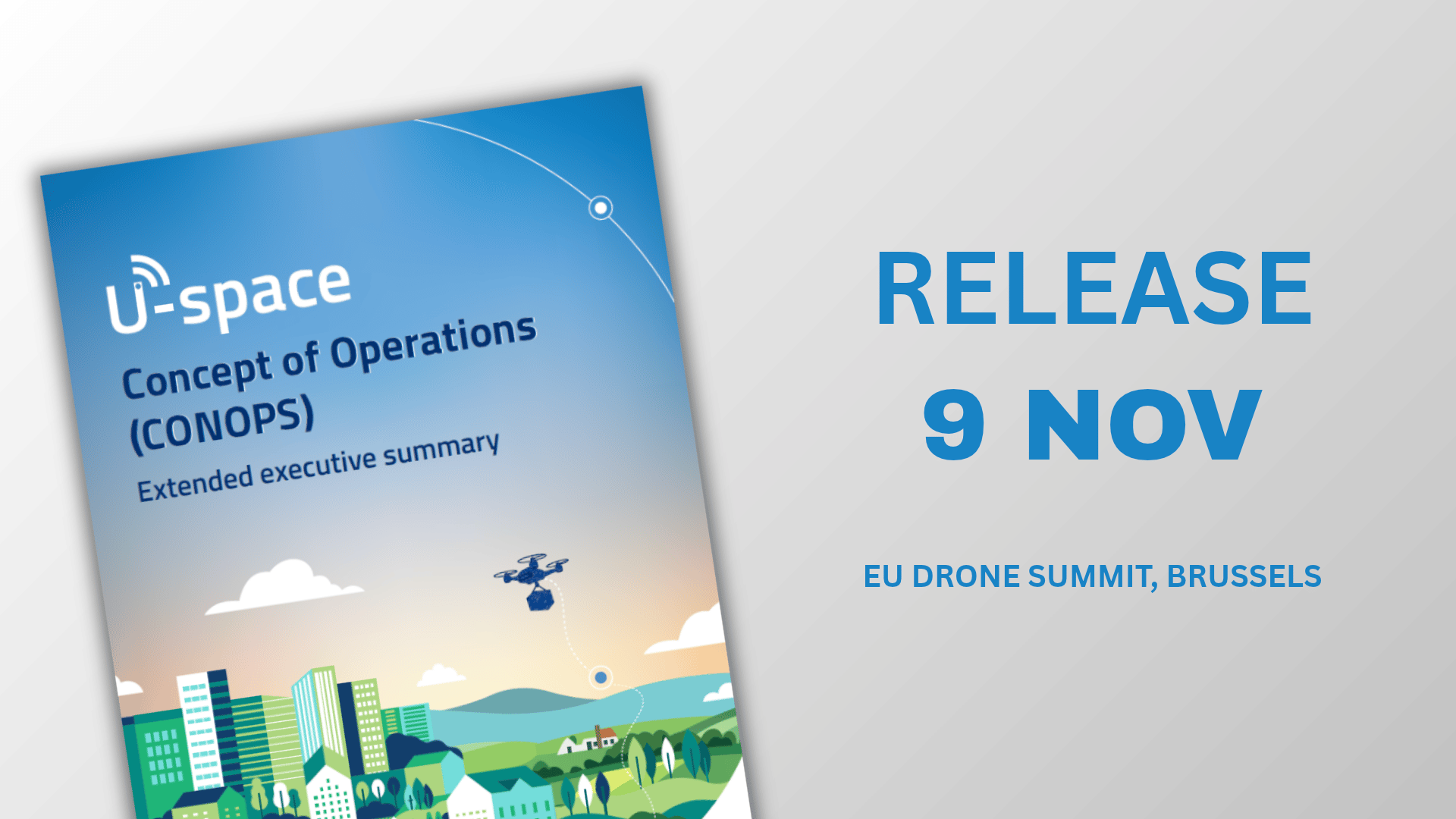
CORUS‑XUAM was delivered by a consortium coordinated by the EUROCONTROL Innovation Hub under the SESAR Joint Undertaking Horizon 2020 framework. Building on the original CORUS project (2019), CORUS‑XUAM incorporated UAM‑specific operational needs and performance considerations, leading to the fourth edition of the European U‑space ConOps.
These outcomes directly addressed previously open questions related to traffic integration, service scalability, safety management and ATM/U‑space coordination, which are now being further consolidated in subsequent SESAR work.
Key outcomes and lessons learnt
Through the execution of six Very Large Scale Demonstrations across Europe, CORUS XUAM delivered a set of concrete and reusable outcomes, including:
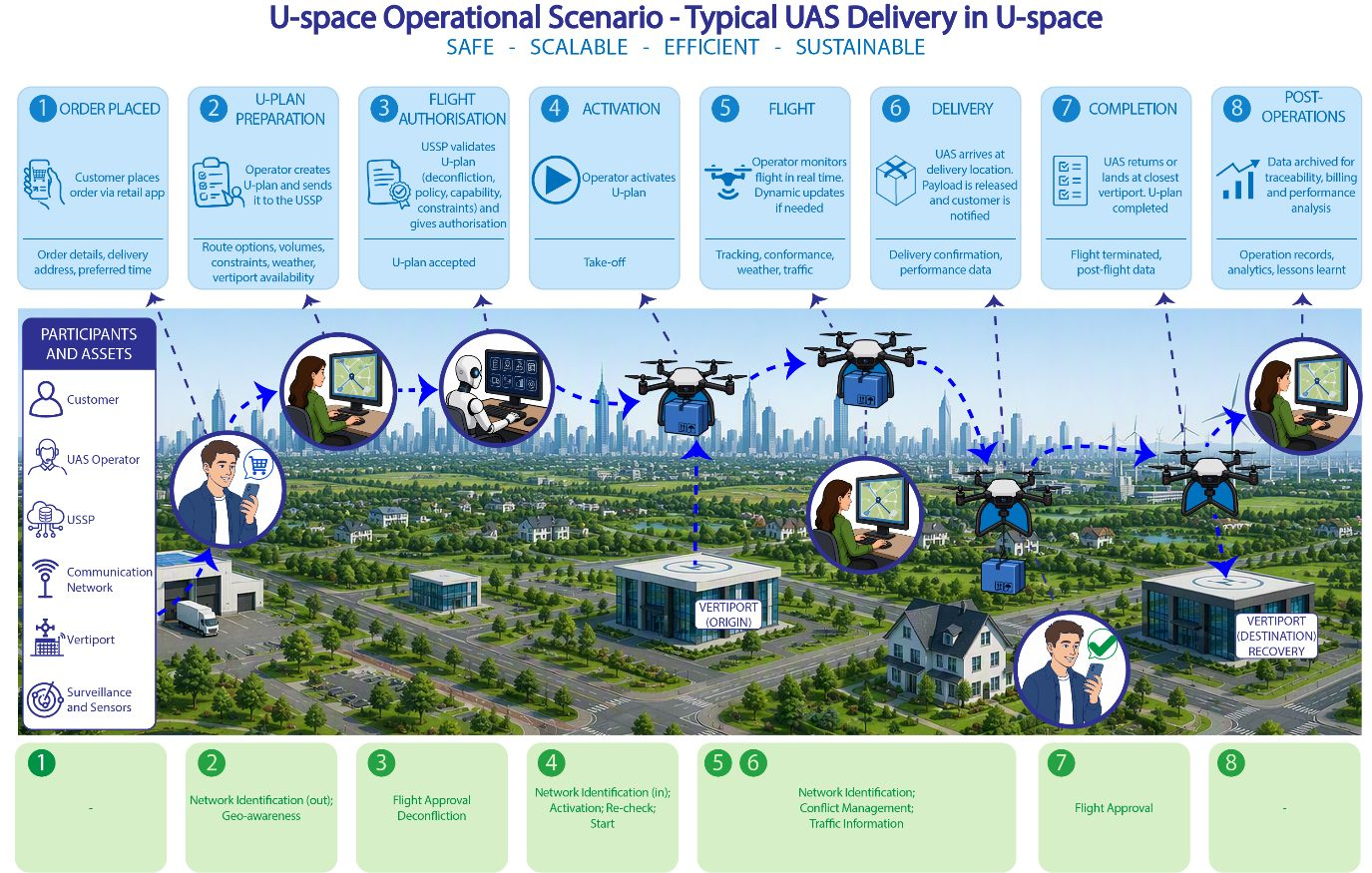
- Validated U space service models (U3/U4) supporting high density, initial mixed UAS/UAM operations
- Operational concepts for integrated ATM–U space coordination, including human in the loop aspects.
- Performance based insights on safety, capacity, cyber security and human factors
- Operational guidance for vertiports and urban access points, including trajectory management and conformity monitoring.
- Evidence based support to regulators, notably EASA, on the feasibility and maturity of integrated U space/UAM operations.
These results confirmed that U‑space must evolve incrementally, with clear staging between restricted UAS operations, advanced U‑space services, and progressively closer integration with manned aviation.
Demonstrations
The validations were the core validation mechanism of CORUS‑XUAM and provided real‑world evidence supporting the operational feasibility, safety and scalability of integrated U‑space/UAM concepts in urban, suburban and controlled airspace environments. They were performed in Belgium, Germany & UK, Italy, Spain, Sweden and France.
Developed solutions and guidelines for safe UAM operations at urban ports, in particular in the urban areas around the Ports of Zeebruges and Antwerp.
Strategic impact and contribution to future work
CORUS‑XUAM played a pivotal role in maturing the European U‑space roadmap, bridging conceptual work and operational reality. The project:
- Delivered the evolution of the European U‑space ConOps (Edition 4.0).
- Identified remaining gaps and research needs in airspace design, flight rules, service maturity and integration strategies.
- Established a shared operational baseline for UAS and UAM integration in Europe.
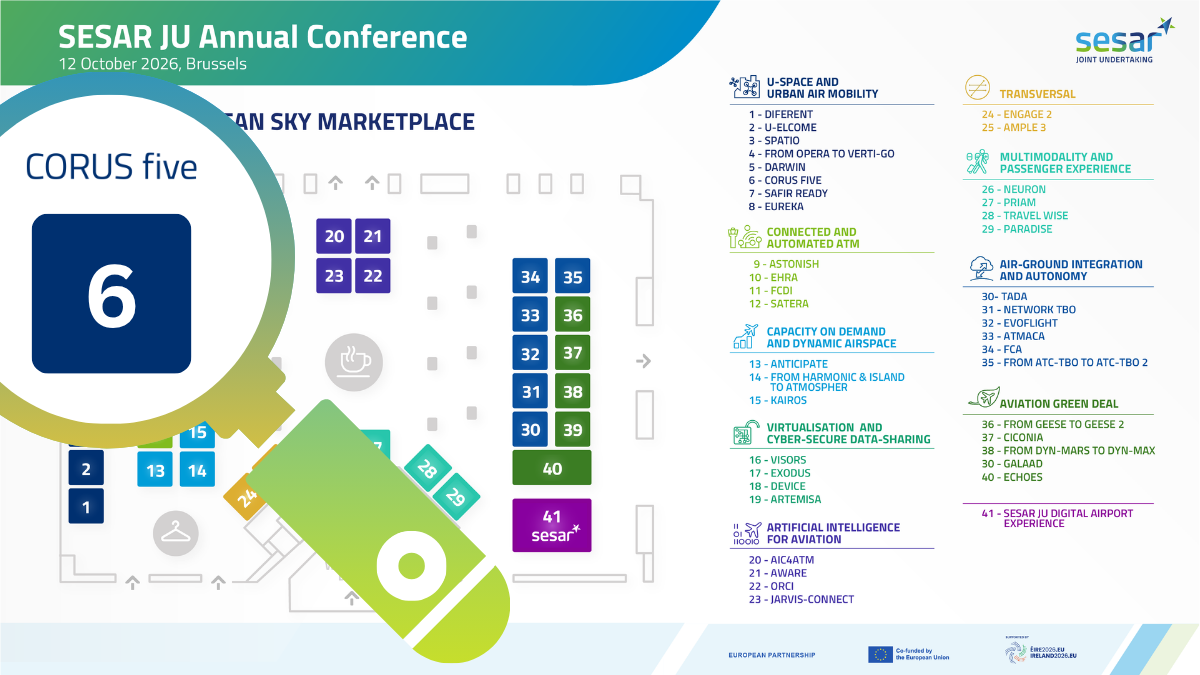
These outcomes constitute the conceptual, operational and empirical foundation on which the CORUS five project is now progressing, enabling the development of U‑space ConOps Edition 5.0 with a stronger focus on:
- extended geographical scalability,
- refined flight rules and airspace structures, and
- long‑term integration of manned and unmanned aviation.
Partners
EUROCONTROL, Groupe Aéroports de Paris, AOPA UK, ASLOGIC, DFS, DLR, Droniq GmbH, DSNA, ENAIRE, ENAV, HEMAV, INDRA, LFV Group, NATS, Pipistrel VS, SkeyDrone, Unifly nv, Universitat Politècnica de Catalunya, Volocopter, M3 Systems, Ehang Holding GmbH, Hologarde, CRIDA, D-FLIGHT, NAIS, DTA, IBG, Linköping University, Citymesh, SABCA.
This project has received funding from the SESAR Joint Undertaking under the European Union’s Horizon 2020 research and innovation programme under grant agreement No101017682.